

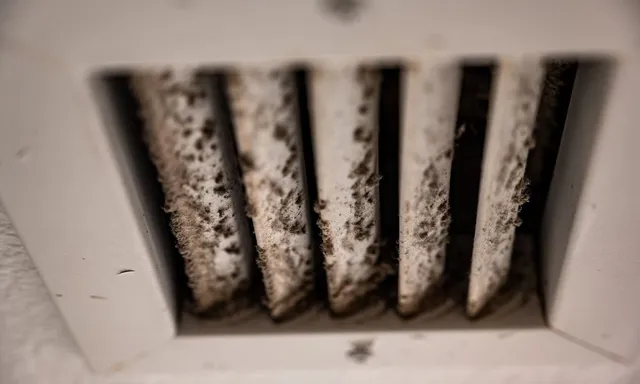
If you have real mould in your ducts, it matters — but the fix is more involved than the “we’ll fog it and you’re done” pitch most companies lead with. Mould in an HVAC system is a legitimate concern because the system recirculates air through the whole house. It’s also the single most common thing dishonest duct cleaners claim you have in order to sell an expensive add-on. This guide covers how to tell the difference, what the real risks are, and what actually resolves it.
A quick note on spelling: we’re Canadian, so you’ll see “mould” throughout — same thing as the “mold” you’ll see on American sources like the EPA.
Signs you may have mould in your ducts
Mould in ductwork often hides, but these are the common signals:
- A persistent musty or earthy smell that gets stronger when the heating or cooling kicks on, and that you can’t trace to a room, the basement, or the fridge.
- Visible growth on or around supply registers, return grilles, or the drip pan and coils near the furnace or AC — black, green, or white patches or fuzz.
- Worsening allergy or respiratory symptoms indoors that ease when you leave the house, particularly during heavy heating or cooling use.
- Recent water intrusion near the HVAC system — a leak, flooding, a failed AC condensate line, or condensation on ductwork.
- High indoor humidity — if your home regularly feels damp or sits above 60% relative humidity, you have the conditions mould needs.
One caution before you panic: not every dark smudge in a vent is mould. Dust, soot, and ordinary debris look similar, and confirming actual mould sometimes takes testing. That distinction matters a lot for your wallet, as we’ll get to.
The real health risks — without the hype
Here’s the measured version, because this topic attracts a lot of exaggeration.
Mould exposure can trigger allergic reactions (sneezing, congestion, itchy eyes, skin irritation), can provoke asthma attacks in people who have asthma, and can cause general respiratory irritation. People most affected are those with allergies, asthma, chronic lung conditions, or weakened immune systems. Because your HVAC system cycles the air in your home multiple times an hour, mould growing in a main duct or on the coils can distribute spores widely rather than staying put.
What the risks are not: the “toxic black mould will make your family gravely ill” narrative is largely overblown. Health authorities have consistently found the evidence linking so-called black mould to severe or unique illness to be limited. That doesn’t mean ignore mould — it means don’t let fear of it push you into a rushed, overpriced “emergency” treatment. Real mould deserves a proper response, not a panic response.
If a company’s opening move is to frighten you, that itself is a red flag.
Why HVAC mould is worth taking seriously
Two reasons it’s a genuine issue when it’s real:
First, distribution. Mould on a bathroom wall stays on the wall. Mould in your ductwork or on your coils gets airflow pushed across it every cycle, which is how a localized problem becomes a whole-house one.
Second, it signals a moisture problem. Mould can’t grow without moisture. Finding it in your ducts almost always means there’s an underlying water source — a leak, a condensation issue, an oversized AC that isn’t dehumidifying properly, or humidity that’s simply too high. Cleaning the mould without finding and fixing that source guarantees it comes back. This is the point the EPA stresses repeatedly, and it’s the part cut-rate operators skip.
What to actually do about it
Here’s the correct sequence. Note that “spray something in the ducts” is not step one, or even step three.
- Turn the system off. Running it circulates spores. Shut it down until it’s been inspected.
- Get a proper inspection. A qualified technician uses cameras to see into the ductwork and evaluates the coils, drip pan, and surrounding areas — and, importantly, looks for the moisture source. If contamination is extensive (the EPA flags roughly 10 square feet as the threshold where professional remediation is warranted), this is not a DIY job.
- Fix the moisture source first. Repair the leak, correct the condensation, address the humidity. Skip this and everything after it is temporary.
- Clean or replace, depending on the material. This is the fork most homeowners don’t know about: mould on bare sheet-metal ducts can be cleaned and, where appropriate, treated. But mould in internal fibreglass insulation or duct board cannot be effectively cleaned — the EPA, NADCA, and the insulation industry all agree it must be removed and replaced. A company that promises to “clean” moldy insulation back to new is either mistaken or misleading you.
- Control humidity going forward so it doesn’t return (see prevention below).
The mould “treatment” upsell — read this before you pay
Mould is the most abused word in this industry. “You’ve got mould” is the go-to justification for tripling a quote, because it sounds urgent and most homeowners can’t verify it on the spot. Protect yourself:
- Be skeptical of an on-sight “mould” diagnosis paired with an immediate expensive fix. Real mould assessment sometimes requires testing, not a glance and a upsell.
- Understand the biocide limits. There are no EPA-registered chemical biocides for use inside internally-insulated (porous) duct systems. So a “we’ll fog your whole system with antimicrobial” pitch, applied to insulated ducts, is selling something that isn’t sanctioned for that use — and doesn’t fix a moisture source.
- Sealants and encapsulation aren’t a shortcut. Coatings should never be sprayed over active mould, a wet liner, or debris. Encapsulating a live problem hides it, it doesn’t resolve it.
- UV lights don’t remove existing mould. They may inhibit some growth, but dead spores and biomass remain allergenic and still have to be physically removed. A UV lamp is not a remediation.
If you want the broader pattern of pricing tricks to watch for, we cover it in our guide to spotting a duct cleaning scam. And if you’re weighing whether the whole service is worth it in your case, our honest look at when duct cleaning is worth the money puts mould in context.
How to prevent mould coming back
Prevention is almost entirely about moisture:
- Keep indoor relative humidity below 60%, ideally between 30% and 50%. A hygrometer costs a few dollars; a dehumidifier is the fix if you’re consistently high.
- Fix leaks and condensation promptly — dry any water-damaged area within 24 to 48 hours, before mould can establish.
- Change your furnace filter on schedule. A loaded filter and damp debris are food and habitat for mould.
- Make sure your AC is correctly sized. An oversized unit cools fast but doesn’t run long enough to pull humidity out of the air, leaving your system damp.
- Insulate ducts that sweat. Condensation on uninsulated ducts is a recurring moisture source.
Mould and Orillia’s climate
Local conditions make this more than a hypothetical here. Humid summers, especially near Lake Couchiching and the surrounding waterways, push indoor humidity up. Basements and crawlspaces in older Orillia homes hold dampness. And seasonal or cottage properties that sit closed up through warm, humid stretches are classic candidates for mould to take hold unnoticed before the season starts.
If you suspect mould in your system, the right first step is an inspection that looks at the whole picture — the ducts, the coils, and the moisture source behind it. Ducts on the Run inspects and services HVAC systems across Orillia, and we’ll tell you honestly whether what you have is mould, dust, or nothing that needs treatment at all. You can also review what duct cleaning costs in Ontario so you know what a fair job runs before anyone quotes you.
Frequently asked questions
How do I know if it’s mould or just dust in my vents? You often can’t tell by looking — dust, soot, and mould can appear similar. Persistent musty odour plus visible growth near moisture is a strong indicator, but confirming actual mould sometimes requires testing. Be wary of anyone who diagnoses “mould” on sight and immediately sells a costly treatment.
Can moldy ducts be cleaned, or do they need replacing? It depends on the material. Bare sheet-metal ducts can usually be cleaned and treated. Mould in internal fibreglass insulation or duct board cannot be effectively cleaned and must be removed and replaced, according to the EPA and industry standards.
Will duct cleaning get rid of mould for good? Only if the underlying moisture source is corrected. Mould returns if the leak, condensation, or high humidity that caused it isn’t fixed first. Cleaning without addressing moisture is a temporary result.
Is mould in air ducts dangerous? It can cause allergic and respiratory symptoms, more so for people with asthma, allergies, or weakened immune systems. The “toxic black mould” panic is largely overstated, but real mould still warrants prompt, proper handling.
Does insurance cover mould in ductwork? Sometimes, if the mould results from a sudden covered event like a burst pipe. Gradual mould from ongoing humidity or an unaddressed leak is usually excluded. Check your specific policy.
Should I turn off my HVAC if I suspect mould? Yes. Running the system circulates spores through the home. Shut it off until it can be inspected.
Sources: U.S. Environmental Protection Agency, Should You Have the Air Ducts in Your Home Cleaned? and Mold Course, Chapter 2.
Ducts on the Run provides residential and commercial duct cleaning and HVAC services across Orillia and the surrounding area. Book an inspection here.