

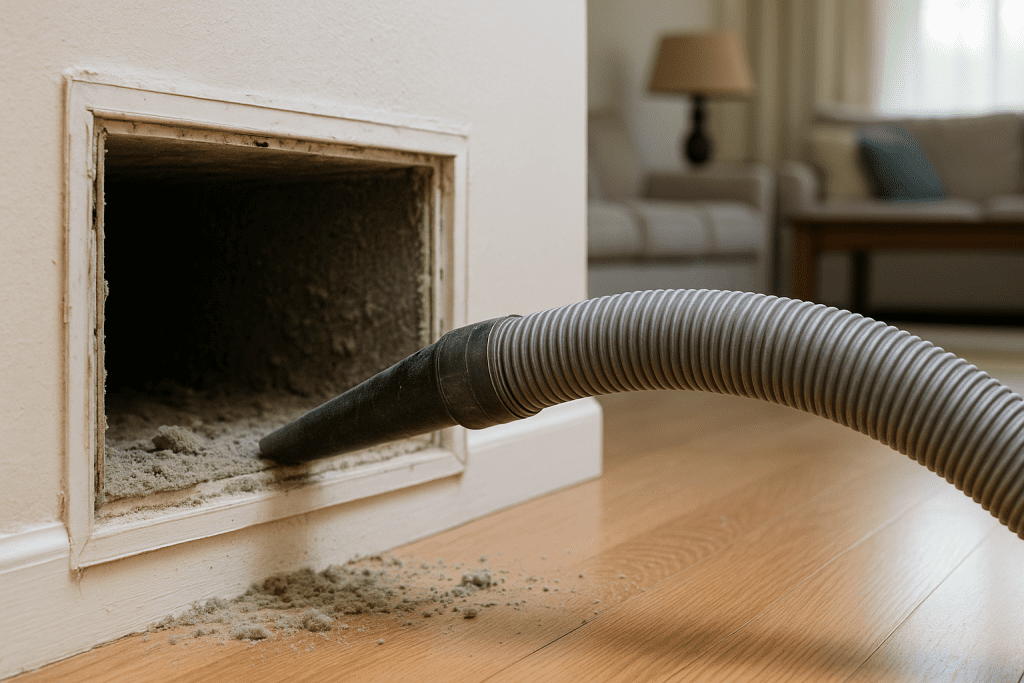
Honest answer: it can help, but it’s a supporting move, not a cure — and it helps most in one specific situation. If your ductwork has a genuine, accumulated load of pet dander, pollen, and dust, cleaning it removes that reservoir and gives you a fresh baseline. What it won’t do is treat your allergies, keep dander from coming back while your pet still lives with you, or replace the things that actually move the needle for allergy sufferers. Any company promising that duct cleaning will “relieve your allergies” is selling you something it can’t deliver.
Here’s the straight version of what’s real, what’s oversold, and where your money and effort actually pay off.
What duct cleaning can and can’t do for allergies
Start with the ceiling, set by the U.S. EPA: duct cleaning has never been shown to prevent health problems, and there’s no conclusive evidence that it reliably lowers the particle levels in your living space. Part of the reason is that a lot of what’s in your ducts sticks to the duct walls rather than circulating into your rooms.
So duct cleaning is not a medical intervention. It doesn’t treat, cure, or prevent allergies — and a duct cleaner isn’t the right person to make any claim about your symptoms. What a reputable company can honestly promise is the removal of accumulated material from your HVAC system, which they can show you with before-and-after photos. That’s a real, verifiable thing. It’s just not the same as “curing your allergies,” and the gap between those two promises is exactly where allergy households get overcharged.
How pet dander and allergens actually move through your home
Understanding the mechanism tells you why cleaning helps sometimes and not others.
Pet dander is light and fine. It goes airborne, gets pulled into your return vents, and circulates through the HVAC system every time it runs. Some settles inside the ductwork. Over months and years, ducts can build up a reservoir of dander, pollen, dust, and skin cells that gets re-stirred with each cycle.
Two things follow from this. First, cleaning out that reservoir genuinely reduces the standing pool of allergens in the system — that’s the real benefit. Second, and this is the part the ads skip: the source is still in your house. Pet dander also comes from saliva and urine, not just shedding, so as long as you have the pet, new dander is produced daily. Clean the ducts and change nothing else, and the reservoir simply rebuilds. That’s why duct cleaning is a reset, not a solution.
When duct cleaning genuinely helps allergy and pet households
It’s worth doing in these specific situations:
- You’ve just moved into a home where the previous owners had pets. You’re inheriting their dander load with none of your own attachment to it. A one-time cleaning gives you a clean starting point.
- It’s been many years (or never) since the ducts were cleaned and you have pets — there’s a real accumulation to remove.
- You’ve found mould in the system. Mould spores are a serious allergen and asthma trigger, and that’s a genuine reason to act (see our guide to mould in your ductwork).
- You can see dander or debris discharging from the vents when the system runs — the allergens are actively re-entering your air.
In each of these, there’s a concrete, removable problem. That’s the test for whether cleaning is worth it — the same test we apply in our honest look at when duct cleaning is worth the money.
When it probably won’t do much
Be honest with yourself here, because this is where the money gets wasted:
If you already change your furnace filter on schedule, you cleaned the ducts a couple of years ago, and your pet situation hasn’t changed, another cleaning is unlikely to change your symptoms. The dander reservoir isn’t the bottleneck — the ongoing source and your filtration are. In that case, spend the money on the list below instead.
What actually helps allergy sufferers (in order)
This is the section the companies selling duct cleaning as an allergy cure won’t write, so here it is plainly. If allergies are your real concern, this is the priority order:
- See an allergist. This is the highest-value step and it’s medical, not mechanical. Knowing what you’re actually allergic to — dust mites, cat dander, pollen, mould — changes everything you do next. It’s also the only thing on this list that can actually treat the allergy rather than just reduce exposure.
- Fix your filtration. A good-quality HVAC filter changed on schedule captures allergens continuously, every time the system runs — which does far more, day to day, than an occasional duct cleaning. For pet households, a MERV 8–13 filter is the usual range; MERV 11–13 for multiple pets or more sensitive allergy sufferers. One caution: don’t jump to the highest rating blindly. A filter that’s too dense for your system restricts airflow and strains the equipment — match the filter to what your furnace can handle, and ask if you’re unsure.
- Add HEPA where it counts. A portable HEPA air purifier in the bedroom — where you spend a third of your day — is one of the most effective, accessible upgrades for allergen reduction. Whole-home HEPA is possible but usually needs a compatible system.
- Control humidity. Keeping indoor relative humidity below 60% (ideally 30–50%) limits both dust mites and mould, two of the biggest allergen sources. In humid stretches that means active dehumidification.
- Control the source. Groom pets outside, vacuum with a HEPA-filter vacuum, keep pets off and away from vents, wash bedding in hot water, and cut down on the carpet and upholstery that trap dander.
Duct cleaning fits underneath this list — a useful one-time reset when there’s accumulation, not a substitute for any of the five things above.
Claims to be wary of
Allergy sufferers are a targeted market precisely because motivation is high and results are hard to verify. Watch for:
- Specific “reduces allergens by X%” statistics. You’ll see claims like “reduces respiratory triggers by up to 80%.” These trace to vague “industry data,” not controlled studies, and no honest company can promise your household a specific number.
- Any health or symptom-relief guarantee. Duct cleaning can’t be promised to relieve symptoms. A company that says it will is telling you how it operates.
- “Antimicrobial” or sanitizing add-ons framed as allergy treatments. These get upsold hard to allergy households. They’re often unnecessary, and for internally-insulated ducts there aren’t even EPA-registered biocides approved for that use. If pricing games are the concern, our breakdown of duct cleaning scams covers the pattern.
Allergies, pets, and Orillia’s seasons
Local conditions make this practical rather than abstract. Simcoe County’s spring and early-summer pollen loads are heavy, and they come in through open windows and outdoor air intakes right as everyone opens up the house. Humid summers near Lake Couchiching push indoor humidity up, feeding dust mites and mould. And plenty of Orillia households have pets and run forced-air heating for six-plus months a year, which recirculates dander constantly.
If you’re an allergy or pet household and you’re not sure whether your ducts hold a real accumulation or you’re just due for better filtration, the honest first step is an inspection. Ducts on the Run will look at your system, show you what’s actually in it, and tell you plainly whether a cleaning will help your situation — or whether you’re better off putting the money toward filters and a purifier. If you’d like to know what a fair cleaning costs first, our Ontario duct cleaning price guide lays it out.
Frequently asked questions
Does duct cleaning help with allergies? It can help by removing accumulated dust, pollen, and pet dander from the system, especially when there’s a real buildup. It is not a treatment or cure for allergies, and shouldn’t be relied on as one. Filtration, humidity control, source control, and an allergist do more.
Will cleaning my ducts get rid of pet dander for good? No. As long as you have the pet, new dander is produced continuously — from shedding, saliva, and urine. Cleaning resets the accumulation; ongoing filtration and source control keep it down.
What filter is best for pet and allergy households? Generally a MERV 8–13 filter, with 11–13 for multiple pets or more sensitivity — but only as high as your system supports without restricting airflow. Change it more often than the box suggests if you have pets.
Is a HEPA air purifier better than duct cleaning for allergies? For ongoing, day-to-day allergen reduction, a bedroom HEPA purifier plus good HVAC filtration usually does more than an occasional duct cleaning. They address different things — filtration is continuous, duct cleaning is a one-time reset.
Can duct cleaning make asthma or allergies worse? Poorly done cleaning can stir up and release particles, which is why proper negative-air/HEPA equipment matters. Done correctly, it shouldn’t worsen symptoms — but it also shouldn’t be sold as a cure.
I have severe allergies — what should I do first? See a board-certified allergist. Symptom management is medical. Home measures like filtration and duct cleaning support that, but they don’t replace a proper diagnosis and treatment plan.
Source: U.S. Environmental Protection Agency, Should You Have the Air Ducts in Your Home Cleaned?
This article is general information, not medical advice — for allergy symptoms, consult a physician or allergist. Ducts on the Run provides residential and commercial duct cleaning across Orillia and the surrounding area. Book an inspection here.